

Hybrid Novelty Concept with Conversational AI Chatbot Interfaces
💡 Conversational Interface Design | Systems Architecture | UX Writing | Interaction Design | AI-Assisted Prototyping
🛠️ Figma | Photoshop | Illustrator | After Effects | Midjourney | ChatGPT API | Google Slides | InDesign | Web.js
👥 Faculty Reviewers | User Testers
Open.ai API and Novelty UI
The Oracle of Design is a conversational interface built to translate complex design frameworks into accessible, character-driven guidance. The system maps user questions to foundational design principles—such as empathy mapping, design thinking, systems modeling, and user journeys—and generates responses that reinterpret these frameworks as narrative archetypes, making design logic intuitive, even for non-experts.


Physical Deck Design
Midjourney and generative fill were used not as shortcuts, but as artistic constraints—ensuring color, lighting, character posture, and world-building remained cohesive across 22 cards. The final deck blends surrealism, fashion, and graphic symbolism into a tactile artifact that mirrors the logic of the conversational system, making abstract design roles and principles physically holdable.

The System Logic
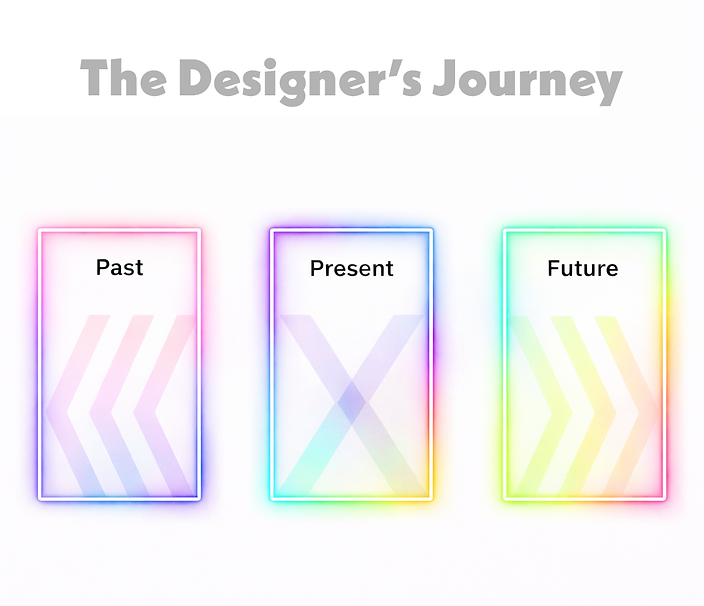
Traditional tarot spreads were reinterpreted as design frameworks: layout patterns that help users make sense of a question through structured prompts. A three-card spread becomes Past–Present–Future in a system-evaluation context. A five-card spread maps directly to the stages of the Double Diamond. This reframing demonstrates how design frameworks can be taught, understood, and even felt through a ritualized storytelling format.


The Outcome
The project was a standout success during demonstrations. Users laughed, engaged deeply, and were genuinely surprised by how accurately the system applied design concepts to real-world, personal questions. Professors noted the clarity with which the interface translated complex frameworks into conversational form—calling it an inventive fusion of interaction design, systems thinking, and narrative UX.
The Oracle became both a teaching tool and a performance piece, proving that intelligence systems can be rigorous and delightfully human.